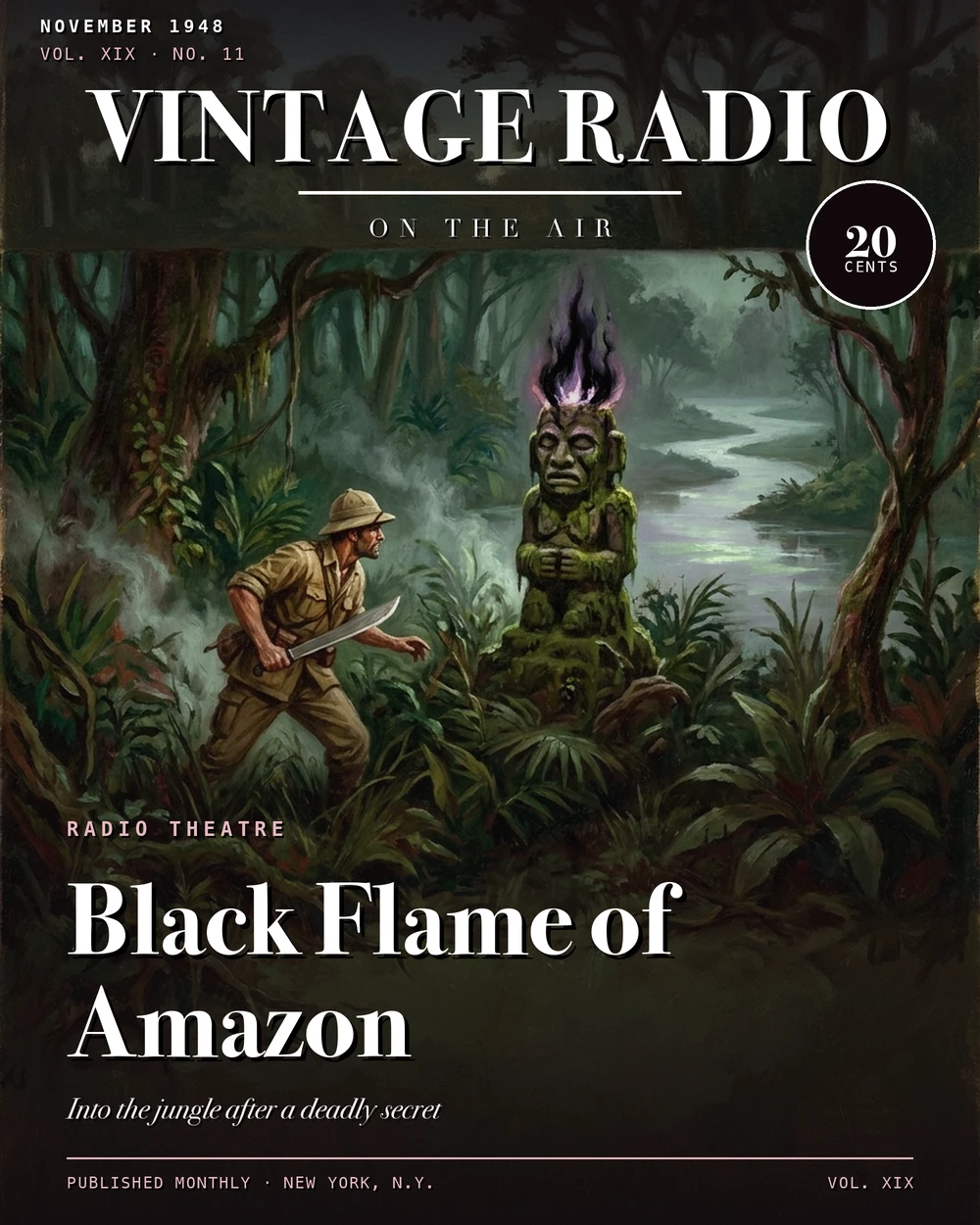
Black Flame of Amazon
A Real Explorer at the Center of a Radio Serial
What set Black Flame of Amazon apart from the run of jungle adventure serials was the man at its center. The protagonist wasn't a generic two-fisted hero but Harold Noice — a name drawn directly from a living, working explorer. The real Noice (1895–1984) had genuine credentials: he joined the Canadian Arctic Expedition in 1915, traveled with Vilhjalmur Stefansson during the discovery of new Arctic lands in 1916 and 1917, led the Wrangel Island relief expedition in 1923, and published With Stefansson in the Arctic in 1924. By the time the series launched in 1938, he had also led an expedition into the Amazon — a journey he would describe in his 1939 book Back of Beyond. The radio serial drew directly on that trip, making it something closer to a dramatized celebrity pulp than a purely invented adventure.
The fictional Noice was described in promotional materials as "an adventurer, explorer, and scientist in the darkest jungles of South America," which wasn't far from what the real man actually did. That grounding in a recognizable, living figure gave the series a dimension that purely fictional jungle heroes lacked. Listeners in 1938 could, in theory, pick up Back of Beyond the following year and read the account behind the drama they'd been following on the radio.
How the Show Was Built and Sold
Black Flame of Amazon was the first sold series produced by TransAir Incorporated, a Chicago-based radio agency formed in early 1938 by former employees of Van Cronkhite Associates Incorporated. The principals were William F. Arnold as president, Ray Launder as vice-president, and John Taylor Booz as secretary. For a newly formed agency, landing a series in regional syndication almost immediately was a significant early result.
The show was distributed as a syndicated transcribed series rather than a single national network broadcast, which shaped both how it reached listeners and how it survived in different markets for years. Its first sponsor was the Hickok Oil Company of Toledo, Ohio, which placed it on the Michigan Network and on individual stations in Toledo, Cleveland, Canton, and Youngstown as a quarter-hour program. From there, additional sponsors carried it into new regions: the Strietmann Biscuit Company and Felber Biscuit Company — both subsidiaries of United Biscuit Company — brought it to Cincinnati's WCKY, Richmond's WRVA, and stations in Kentucky, North Carolina, and West Virginia. The Independent Packing Company sponsored it in St. Louis and Jefferson City, Missouri in 1940. Pacific States Oil Company underwrote it over San Francisco's KFRC in 1941. Industry records confirm the show was still on the air as late as 1943, meaning what looked from the outside like a 1938 debut was actually the beginning of a multi-year regional run.
The Sponsor Strategy and the Explorer's Club
The sponsors who backed Black Flame of Amazon understood exactly who was listening and built their marketing around the show's young audience. Hickok Oil, whose Hi-Speed gasoline brand anchored their identity, used the series to launch the Hi-Speed Explorer's Club — a membership organization for child listeners. Company executives claimed that over 450,000 youngsters joined the club, a figure that speaks to the show's reach across its regional markets even if it's hard to verify precisely.
Premium merchandise came with the territory. Promotional materials tied to the Explorer's Club included membership kits and stamp and label sets that children could mount on maps — exactly the kind of tactile, collectible item that turned a radio program into something a kid could hold in their hands. The series was promoted as educational as well as entertaining, which helped sponsors frame it as wholesome family listening. That framing also made it easier to place across a range of regional outlets with varying standards for children's programming.
The Ensemble and the Junior Explorer Format
The fictional Harold Noice didn't travel alone. His ensemble included Keyto, a native guide; Pedro, an aide; Pat Donovan, a pilot; and — crucially — Jim and Jean Brady, two young friends who accompanied him on his Amazon adventures. The Bradys were a deliberate structural choice. By including both a male and a female juvenile character, the series gave listeners of either gender a direct point of entry into the story. Jim and Jean weren't sidekicks in the dismissive sense — they were the show's bridge to its audience.
Black Flame of Amazon is considered one of the earliest radio programs to use what became known as the "junior explorer" format, where young characters embedded in an adult adventure allowed children to experience the story as participants rather than observers. The formula would become standard in children's adventure programming through the 1940s, but in 1938 it was still relatively fresh. The show's themes — loyalty, bravery, the confrontation between good and evil, and the navigation of a world full of myths and physical danger — were familiar adventure territory, but the ensemble structure gave them a specifically child-oriented shape.
The Serial Structure and What Survives
The show aired Monday through Friday in the evenings, a schedule designed to build a weekly habit among young listeners and keep them returning for the next installment. Episodes were numbered by chapter rather than given individual descriptive titles, which underscored the serial's nature as one long unfolding story rather than a collection of self-contained adventures. The chapter numbering in the surviving catalog — running from Chapter 21 through Chapter 76, with gaps — suggests a run of at least 78 episodes by one count, though the full original episode count across all its regional broadcasts may have been higher.
Seventeen episodes are held in the current catalog, with chapter numbers that include 21, 42, 43, 53, 54, 55, 58, 59, 60, 62, 63, and 76. The gaps between those numbers are a reminder of how syndicated transcription series worked: different stations in different markets aired episodes on different schedules, and the survival of recordings depended on what individual stations or collectors happened to preserve. What remains is a partial but usable window into a show that was clearly more substantial and longer-lived than its 1938 premiere date alone would suggest.
Production placed an emphasis on sound effects and audio craft intended to put listeners inside a jungle environment — the kind of immersive audio landscape that the adventure serial format demanded. The stories incorporated local Amazon myths and legends as antagonists and plot drivers, which gave the writing a texture beyond simple good-versus-evil confrontation, even if the underlying moral framework stayed straightforward.
Where It Fits in Adventure Radio
Black Flame of Amazon belongs to a specific and busy moment in radio adventure. Programs like The Man Called X and Captain Midnight occupied neighboring territory, building loyal audiences through serial plotting, exotic settings, and a mix of genuine peril and juvenile wish fulfillment. What distinguished Black Flame of Amazon within that company was the real-world anchor of Harold Noice and the explicit junior explorer structure. Most jungle adventure programs of the era invented everything — the hero, the setting's specifics, the supporting cast. This one started from an actual expedition and built outward.
The show's multi-year run across regional markets, its rotating roster of sponsors, and its documented audience of hundreds of thousands of young Explorer's Club members suggest it found a durable audience even without a national network platform. TransAir Incorporated built it as their first major property, and by the evidence of the broadcast record, it served that purpose well enough to keep selling into new regional markets for the better part of five years.